
Are you new to Python programming?
Python is a free open-source programming language that supports multiple approaches to programming including object-oriented programming, scripting and automation. It is widely used for web development, data science and machine learning. Whether your goal is data analysis, building applications, or automating tasks, python offers an extensive library ecosystem and active community to help beginners succeed.
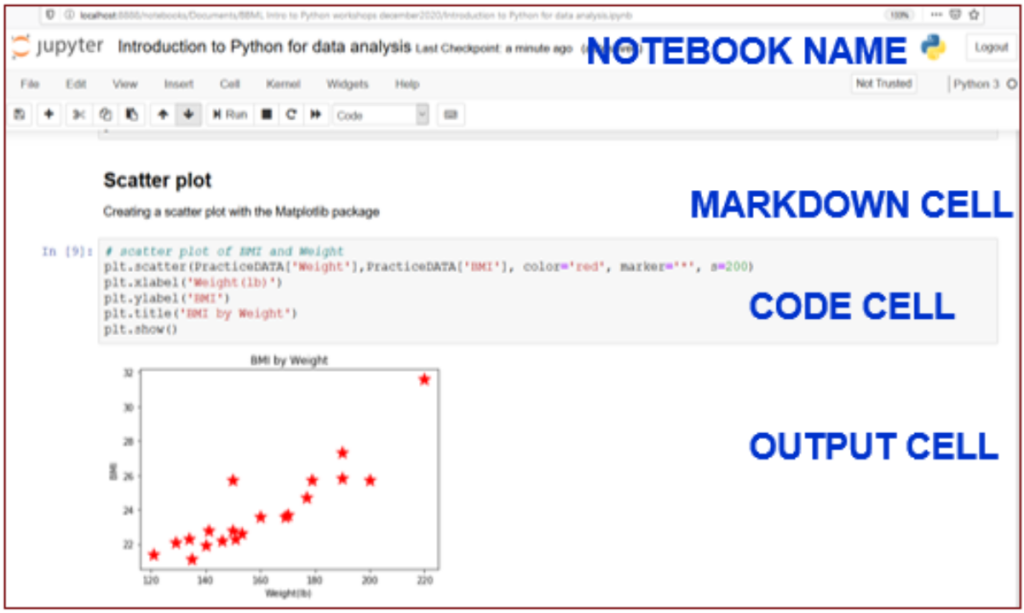
Bernard Becker Medical Library supports a variety of helpful resources for learning Python including free beginner-friendly introduction to Python workshops. These hands-on sessions cover basic information about Python syntax, Jupyter Notebook, how to import CSV files, how to create plots, and some popular Python libraries commonly used for data analysis such as Pandas, NumPy, Matplotlib, Seaborn and Plotly Express. Each workshop starts with a brief presentation to introduce basic Python concepts, followed by practical demonstrations in Jupyter Notebook (Figure1). This format provides real-world experience, prepares participants for ongoing learning, and fosters collaboration.
Why use Jupyter Notebook?
It is a widely used interactive web-based environment developed by Project Jupyter, a non-profit open-source initiative for free software, web-based tools, a supportive community and services for interactive computing across all programming languages. Jupyter Notebook has many features great for executing Python code, explaining code, exploring and visualizing data, and creating sharable educational or collaborative workflows. Jupyter lab, extends these capabilities with a flexible interface for managing multiple notebooks, files and workflows.
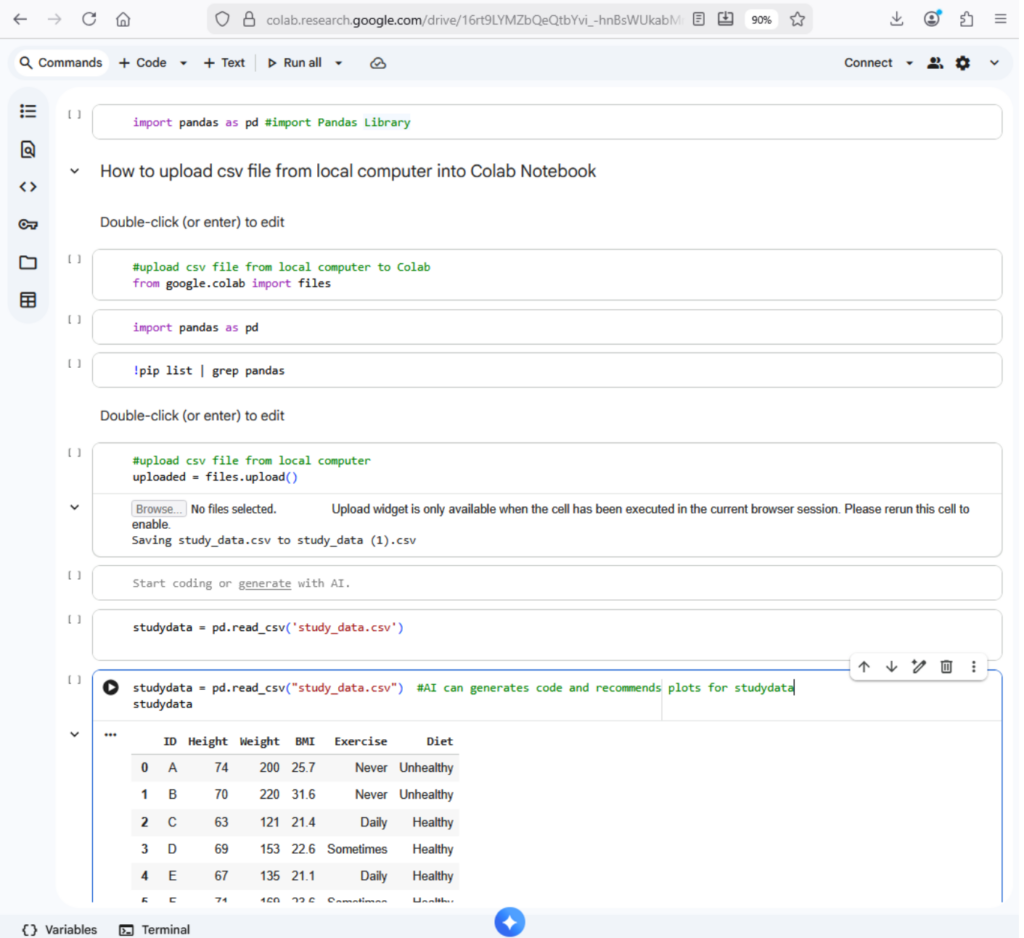
Jupyter Notebooks can be hosted on various platforms. For example, Google Colaboratory or Colab is basically Jupyter Notebook on Google’s platform, to allow access to notebooks without the need for local software installation (Figure 2). Colab has built-in Artificial Intelligence (AI) for use if desired. Learners can create a new colaboratory notebook from here – https://colab.google/ .
How can AI assist beginners learn Python?
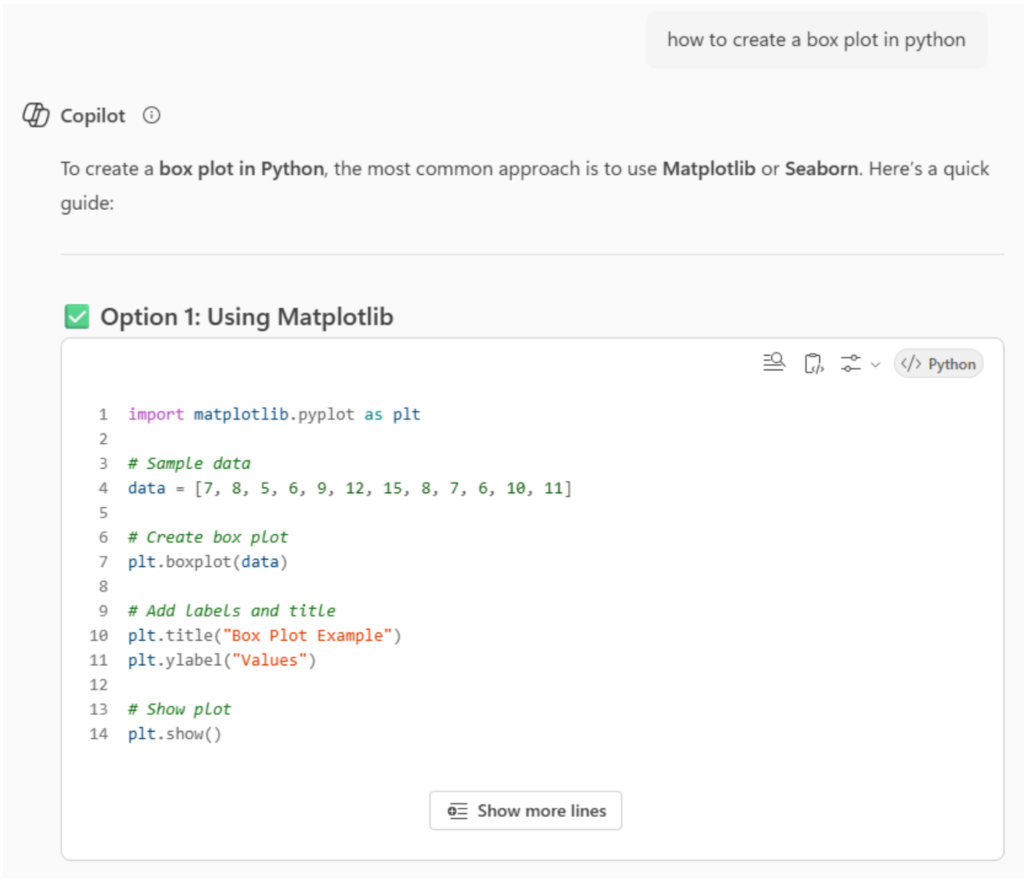
AI assistance is available within Google Colabolatory and can be enabled in Jupyter software if desired. Learners may also explore other platforms such as Claude AI, ChatGPT, Copilot and others. As outlined in this presentation, effective prompting (specific honed requests) can make AI a valuable resource for beginners learning Python. AI can generate code, provide data, suggest tutorials, organize the process, summarize ideas and recommend communities to join for ongoing learning. (Figure 3). However, learners must apply caution when using AI – code validation and content review are essential as AI can make mistakes and AI-generated content may be incorrect.
Jupyter Notebooks and AI-powered tools make learning Python more accessible to beginners. Are you a beginner who would like to learn how to run Python code? Would you like to join a Python community at WashU? If so, explore Becker Medical Library’s Research Computing service for beginner-friendly trainings and to connect with other WashU researchers by joining the research computing mailing list or the #python channel in the ICTS Precision Health Slack.
If you have questions, don’t hesitate to contact Maze Ndukum at ndukummaze@wustl.edu.
Resources:
Project Jupyter – https://docs.jupyter.org/en/latest/
Some resources for learning Python: https://wustl.box.com/s/j1loutnyirpplhwdkulb2dgw6ez0qprc