
Since October 2022, the Bernard Becker Medical Library has been monitoring ORCID adoption among the Washington University School of Medicine in St. Louis faculty. This process was in response to the August 2022 White House Office of Science and Technology Policy memo: Ensuring Free, Immediate, and Equitable Access to Federally Funded Research, (OSTP Memo). In July 2024, the NIH released a notice announcing the requirement of common forms for NIH grants to be implemented in 2025. Preview versions of these forms were announced in September 2025, and the NIH strongly encouraged researchers to begin connecting their ORCID iDs to both eRA Commons and SciENcv.
The bi-annual analysis has been conducted to not only gauge the adoption levels of an ORCID iD for WashU Medicine faculty but also connect it to research outputs and funding. The most recent analysis was conducted in October 2025. Prior analyses were conducted in October 2022, July 2023, January 2024, September 2024, and March 2025.
Methodology:
WashU Medicine’s Research Profiles platform was used to identify faculty researchers. The most recent faculty data was pulled in October 2025 in conjunction with Research Profiles updates. A total of 3,090 faculty memberswere identified with primary appointments at the School of Medicine. The faculty members were categorized at the department level as indicated in Research Profiles. Additional searches were conducted to confirm an ORCID iD if one was not included in the faculty researcher’s Research Profiles record. The search was conducted at ORCID.org, Scopus, and at the individual research output level. If an ORCID iD could not be verified, it was marked as no ORCID iD for the faculty researcher.* The review looked at ORCID iD adoption, research outputs tied to an ORCID iD record, and WashU faculty receiving awards from National Institutes of Health (NIH) funding per NIH RePORTER (per report executed Oct. 15, 2025) or from National Science Foundation (NSF) per NSF Award Search (per report executed Oct. 15, 2025) tied to ORCID iD record.
*Reviewer acknowledges an ORCID iD might exist for the faculty researcher but was unable to verify it so defaulted to none.
Summary:
Overall, 67.5% of WashU Medicine faculty have an ORCID iD. Of the 24 departments, all but one have more than 50% of their faculty with an ORCID iD.
Total research output (number of published articles) per Research Profiles for WashU Medicine faculty at time of review was 181,620. Of this, 89% of the research output is connected to a faculty researcher with an ORCID iD.
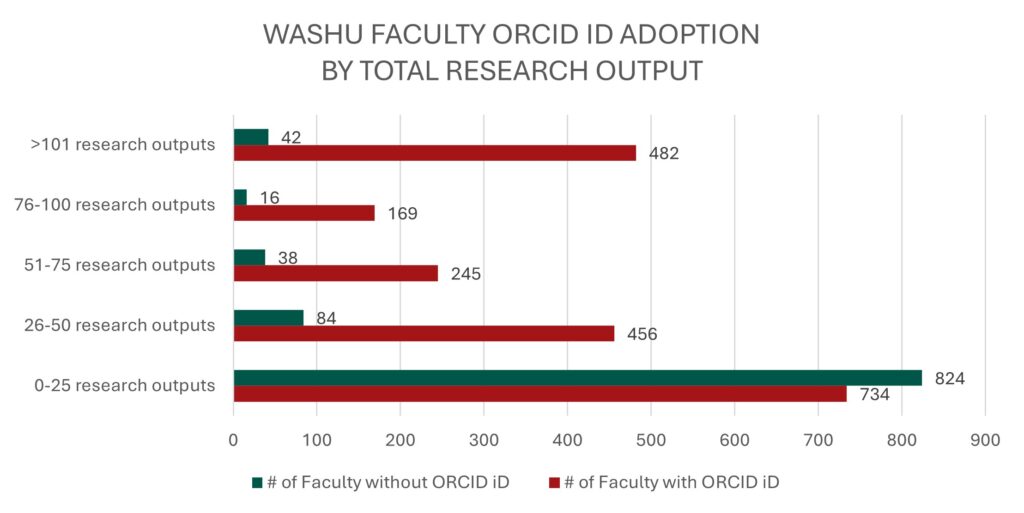
ORCID iD use does increase as total number of research outputs increases. Of faculty researchers with more than 100 research outputs, 92% of those have an ORCID iD. The lowest adoption rate is seen with those faculty researchers having less than 25 total research outputs.
| Points of Analysis | Oct 2022 | July 2023 | Jan 2024 | Sep 2024 | Mar 2025 | Oct 2025 |
| Faculty with ORCID iD | 41% | 57% | 61% | 61% | 64% | 67.5% |
| Depts ≥ 50% faculty with verified ORCID iD [24 depts] | 9 depts. | 20 depts. | 21 depts. | 20 depts. | 21 depts. | 23 depts. |
| Total research output tied to ORCID iD | 62% | 78% | 84% | 85% | 87% | 89% |
| Faculty with >100 research outputs with ORCID iD | 67% | 81% | 87% | 88% | 90% | 92% |
| NIH funding tied to ORCID | 77% | 94% | 97% | 97% | 98% | 99% |
| NSF funding tied to ORCID | n/a | n/a | 100% | 100% | 100% | 100% |
| Affiliation available in ORCID record | n/a | n/a | n/a | n/a | n/a | 39.8% |
NIH awards to Washington University for FY22-FY25 (as of Oct. 15, 2025) were in excess of $2.9B for School of Medicine faculty. NSF funding for Washington University was reviewed for 2022-2025 (as of Oct. 15, 2025) and totaled $4.9M for School of Medicine faculty. A total of 775 researchers received funding. The significant majority, 99%, of funding received can be connected to a faculty researcher with an ORCID iD. Only 1% of the NIH awards, or approximately $38M, did not meet the OSTP research requirements due to lack of a verified digital persistent identifier for the faculty researcher. All of the NSF awards met the OSTP research requirement.
Since the initial analysis report in October 2022, the percentage of faculty with an ORCID iD has increased 26.5%. Given this increase in ORCID adoption, an additional analysis point was added for the October 2025 report. We wanted to know if faculty were not just adopting an ORCID iD but also populating it to provide a reader with relevant information. We reviewed the amount of ORCID record information available for each researcher. Ideally looking to determine a researcher’s affiliation immediately when viewing the public record. Currently, only 39.8% of the faculty profiles can immediately be identified as WashU faculty. The criteria for the levels of information can be found below.
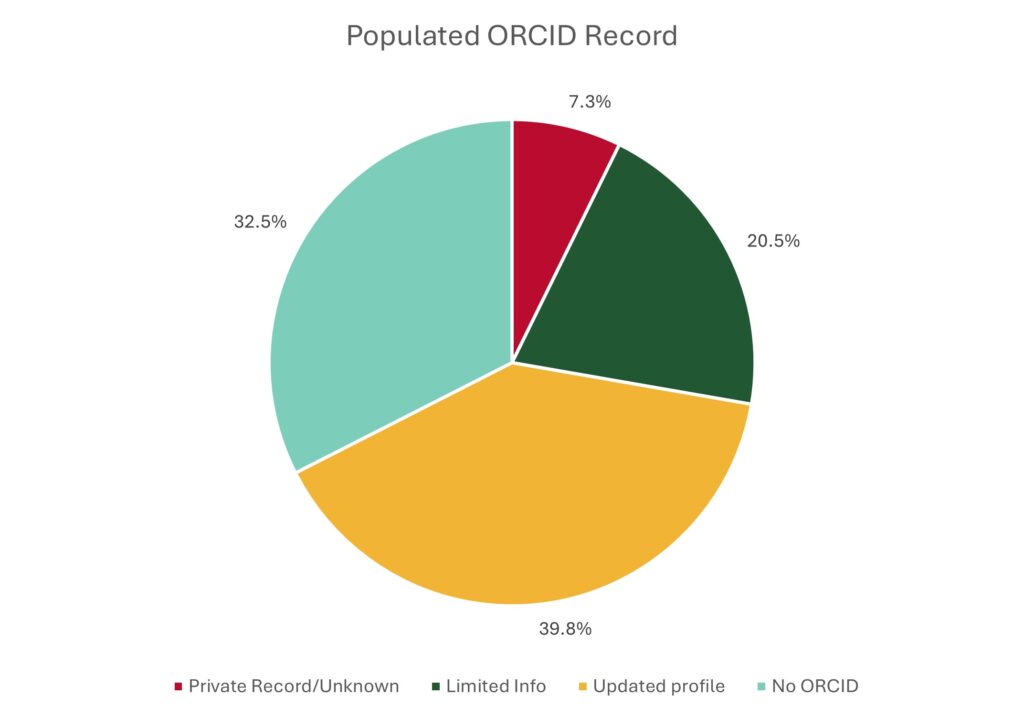
ORCID record information criteria points:
- No ORCID – Researcher does not have a verifiable ORCID iD.
- Updated Profile – Researcher’s affiliation with WashU is immediately available from the public record.
- Limited Info – Researcher has information populated in ORCID record but affiliation not immediately available.
- Private Record/Unknown – Researcher does not have a public ORCID record. No additional information is available.
This newest analysis point opens up a new area for educating our faculty. ORCID adoption is important, and having an ORCID iD is becoming a necessity for things like publications and grant applications. Beyond having the ORCID iD, we need to look at making the ORCID record a functional tool. A record where, at minimum, an individual’s affiliation and area of expertise can be identified and viewed quickly.
If individual faculty or a WashU Medicine department would like more information about ORCID, please contact me, Brittney Sandler @ sandler.brittney@wustl.edu. I’m happy to answer questions and assist with getting ORCID iDs connected, and records populated.
Resources: