
May 1st, or May Day, has been a holiday associated with the arrival of summer for millennia. But dancing around maypoles is not the only way that you can celebrate the day—it can also be a good day for those suffering from scrofula to petition for divine assistance.
Scrofula is a disease that we don’t hear about very often in the 21st century. In his encyclopedic dictionary of medicine published in 1745, the English physician Robert James (1703-1776) described it as a disease that is especially present in those who “early shew an uncommon Vivacity of Mind, and Forwardness of Understanding” and arises from an abundance of hot, sharp humors, conditions that were passed on from the parents. Its calling card was a “hard, glandulous Tumor, usually of the Skin, seated principally on the Sides of the Neck.” We now know the disease is in fact an infection caused by tuberculosis bacteria that manage to travel from the lungs to the lymph nodes, causing the characteristic swelling at the neck.
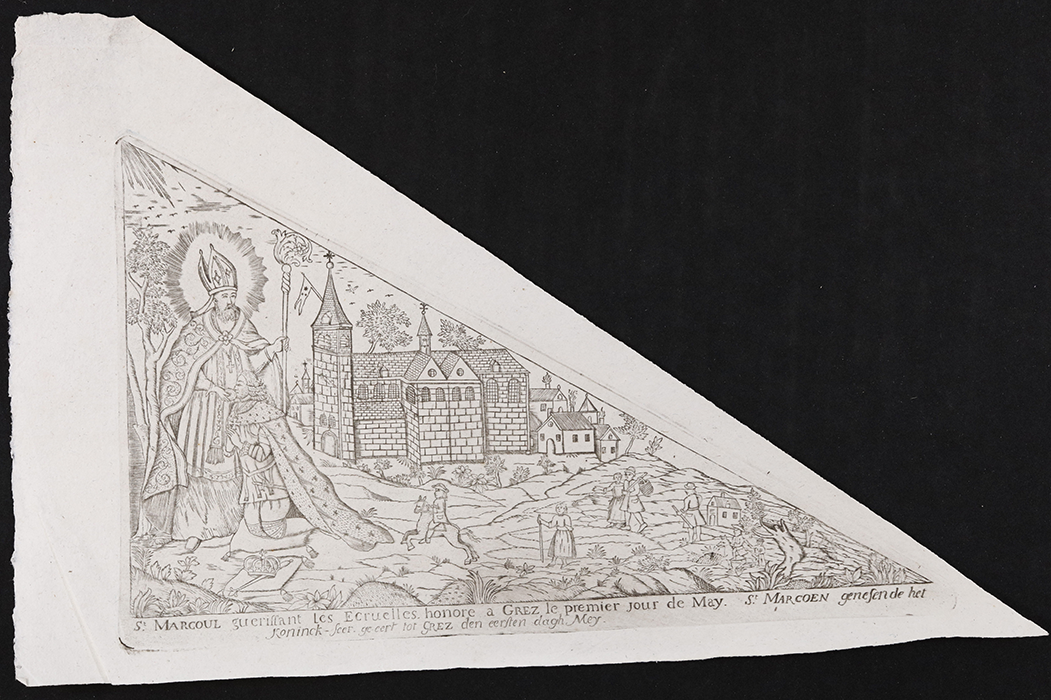
But what does May 1st have to do with this? May 1st is the Feast Day of Saint Marculf (or Marcouf), one of the saints associated with curing skin diseases, and scrofula was his specialty. This paper pennant, one of five held at Becker Library, was a souvenir for pilgrims who made their way to the Church of St. George at Grez-Doiceau in Belgium to pray for help from the saint. When they returned home, they could display it in their homes as a tool for continued prayer or meditation.
While the word scrofula comes from scrofa (the Latin word for sow), the disease was also known as the King’s Evil. The key for this moniker can be seen in the two figures on the left side of the pennant. The larger figure is Marculf himself, identifiable by his abbot’s miter and crozier. Kneeling before him is the King of France, the crown and scepter of his station on a pillow by his side. In the English and French royal traditions, it was believed that monarchs had the ability to cure scrofula through touch, a gift granted to them by God. In both countries, rulers held events where the afflicted from all social classes could come and be touched. In England, this tradition continued—albeit with interruptions—until the 18th century, while the last time it was performed in France was at the coronation of Charles X in 1825.
As for James, he tells us that, “Whence this Distemper comes by the Name of the King’s Evil, there is something in it so remote from all good Sense, since it can take place only on a deluded Imagination, that I think it justly banished with the Superstition and Bigotry that introduced it.” He offers several other options for treating scrofula, all of which essentially rely on humoral theory: a dietary regimen based on the patient’s individual constitution (hot and dry or cold and moist, and so forth), pharmaceutical remedies (based on herbs and minerals), or sometimes surgical intervention on the swollen glands.
The true cure for scrofula is, of course, antibiotics. But the story of the King’s Evil reveals how faith and medicine have been tightly entwined throughout human history. One of the most common reasons medieval pilgrims undertook long and arduous journeys to religious shrines was in hope of being healed, and even today, sites such as Lourdes in France remain powerful sites for those seeking healing through faith. Artifacts such as this pennant stand as a testament to this long and complicated story.