
I previously wrote a blog titled “NIH DMS Plan Format Updates, 2026 Edition: What to Know” on March 27, 2026, before the new 2026 Data Management and Sharing (DMS) Plan format took effect on May 25, 2026 (NOT-OD-26-046). This blog post builds on that earlier article by providing additional clarifications, implementation guidance, and newly available resources that have emerged since the 2026 Pilot DMS Plan format was introduced. The final version of the 2026 Pilot DMS Plan format also introduced Not Applicable as a response option in addition to Yes and No.
The new 2026 Pilot DMS Plan Format Page (DOCX, 37 KB) as shown in Figure 1, has seven Elements total, where Elements 1-3, 5, and 7 allow only Yes/No/Not Applicable answers, while Elements 4 (justifications for limiting scientific data sharing) and 6 allow narrative answers with a word limit (300 for Element 4 and 100 for Element 6). I called these Elements Questions in my March blog post and during my April 8th webinar titled “NIH & NSF DMSP Updates and New Requirements” (recording and slides) since it is structured like Questions, unlike the six Elements in the 2023 optional format page, which required a narrative description. Because NIH consistently refers to them as Elements in official notices and guidance, investigators should use that terminology when communicating with NIH.
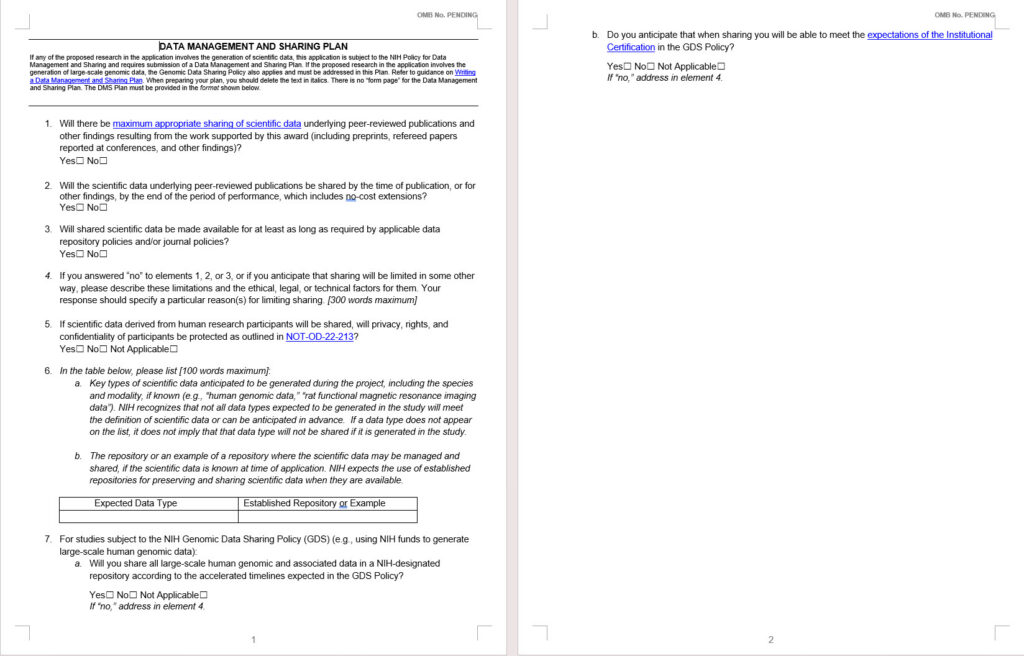
Additional Clarifications from NIH OPERA on the New DMSP Format
I have been communicating with the NIH Office of Policy for Extramural Research Administration (OPERA) regarding implementation details and have summarized NIH OPERA’s additional clarifications in two slides during my April 8th webinar. Since then, I have sought further clarification on whether NIH will accept other templates as long as they follow the seven Elements outlined on its 2026 Pilot DMSP format page. Despite its name, the Pilot DMS Plan format is not optional. NIH OPERA has clarified that all NIH Institutes and Centers are expected to use this format for applicable applications unless a NOFO specifies otherwise. Below is the summary of those clarifications.
- Required across all NIH ICs: The new format is required uniformly for all applications with due dates on or after May 25, 2026, unless otherwise specified in the NOFO
- Pilot but NOT optional: Although NIH refers to it as a pilot, the DMS Plan format downloaded from the NIH website is the required template for preparing NIH DMS Plans. Unlike the 2023 optional format page, which allowed applicants to use other templates as long as all six Elements were addressed, applicants are expected to use the NIH template for all applications with due dates on or after May 25, 2026, unless otherwise specified in the NOFO.
- NIH does not anticipate publishing sample DMSPs in the new format.
- NIH websites, FAQs, and other resources are being updated
- Word limits: Although eRA is not currently validating the word counts for Elements 4 and 6, NIH expects applicants to adhere to the limits specified in NOT-OD-26-046 (300 words for Element 4 and 100 words for Element 6).
- One mailbox for all DMS questions: All DMS-related questions go to GrantsCompliance@od.nih.gov, not sharing@nih.gov
- DMSP review timing is unchanged: DMSP review still occurs at Just-in-Time (JIT)
- IC-specific requirements: Recipients must follow the new format only. IC-specific elements such as the NIMH data validation schedule (NOT-MH-23-100) are not part of the new standardized format.
Budgeting for Data Management and Sharing
During the June 2026 COGR Meeting, Michelle Bulls, Director at NIH OPERA, gave an NIH update in which she mentioned that NIH is seriously considering moving the DMSP submission to the JIT phase since it is not reviewed until then. If NIH adopts this change, it could help streamline the application process. However, investigators should still develop their DMS Plan during the grant application stage because the DMS budget is reviewed before applicants are selected for JIT submission. Since the DMS budget justification must be based on the DMS Plan, having a well-developed plan during proposal preparation remains important for requesting appropriate resources to comply with the NIH DMS Policy. The anticipated costs across common DMS budget categories include:
- Data curation and preparation
- Supporting documentation (e.g., readme files, data dictionaries)
- Repository deposit fees
- Storage and platform costs
- Personnel effort related to data management and sharing
For additional information on how to budget for DMS, please visit the NIH website on Budgeting for Data Management and Sharing and watch the 6-minute FASEB DataWorks! Video on “Budgeting for Data Management in NIH Grants”
Write Element 6 with Future RPPR Reporting in Mind
Although Element 6 is limited to 100 words, investigators should think beyond the grant application when preparing this section. Beginning with Research Performance Progress Reports (RPPRs) submitted on or after October 1, 2024, NIH asks recipients whether scientific data have been generated, whether they have been shared, where they were shared, and under what persistent identifier (PID), such as a DOI or repository accession number. For additional information, see the eRA webpage: Information on New Data Management and Sharing (DMS) Policy Questions in RPPRs (October 1, 2024 and Later).
Based on my experience assisting investigators with RPPRs under the NIH Data Management and Sharing Policy, I recommend organizing Element 6 by shareable dataset rather than by experimental aim or analysis. Data types that are expected to be deposited together in the same repository should be grouped into a single dataset associated with one repository and one persistent identifier whenever appropriate. This organization not only produces a clearer DMS Plan but also makes annual RPPR reporting much easier because investigators can directly map each dataset to its repository and DOI (or other PID) instead of reconstructing how multiple experiments were combined for sharing after the project is underway.
At Becker, we take future RPPR reporting into account during DMS consultations by reviewing the NOFO, Specific Aims, and Research Strategy to identify anticipated data types, their sources, and appropriate repositories before the DMS Plan is submitted. Our goal is to help investigators develop a DMS Plan that not only meets NIH requirements at the time of submission but also supports efficient RPPR reporting throughout the life of the award.
Resources to help you write DMSP in the new format
If you prefer to prepare your DMS Plan yourself, the following resources can help you develop a plan using the 2026 format. However, we encourage investigators to request a consultation with the Becker DMS team to ensure that all anticipated data types are identified, repository selections are appropriate, and the plan supports efficient annual RPPR (Research Performance Progress Report) reporting of DMS activities. We typically request the NOFO number, targeting NIH IC, Specific Aims page, and the Research Strategy section. Together, these documents allow us to identify all anticipated data types and their sources, evaluate repository requirements, determine whether additional sharing obligations apply, and ensure that the DMS Plan accurately reflects the proposed research.
- Example DMS Plans using the new 2026 format
- WUSTL Grants Library: You need to log in using your WUSTL key to view sample plans. The collection includes Data Management and Sharing Plans from WashU investigators that I have hand-selected as exemplary plans across a variety of NIH Institutes and Centers (ICs), activity codes, and DMS Plan formats. At present, the library contains 48 DMS Plans representing 11 activity codes (including R01, K08, R03, R21, R35, U01, K22, K99, P30, and others), 12 NIH Institutes and Centers, and five DMS Plan formats (including the 2023 optional format page, the 2026 pilot format page, FDP pilot templates Alpha and Bravo, and AHRQ template). The Submitted folder currently includes five DMS Plans using the new 2026 NIH Pilot format (three R01s, one K08, and one R21), and additional examples will be added as I review more plans. Once those applications are funded, they will be moved to the Awarded folder. In addition, I have recently assisted several investigators with revising their awarded DMS Plans using the new 2026 format as part of the RPPR process. As those revised plans are approved by NIH, they will also be added to the Awarded folder. Look for file names containing “2026-Pilot-DMSP.”
- Annotated Example Plan developed by the Working Group on NIH DMSP Guidance is publicly available on their OSF project page.
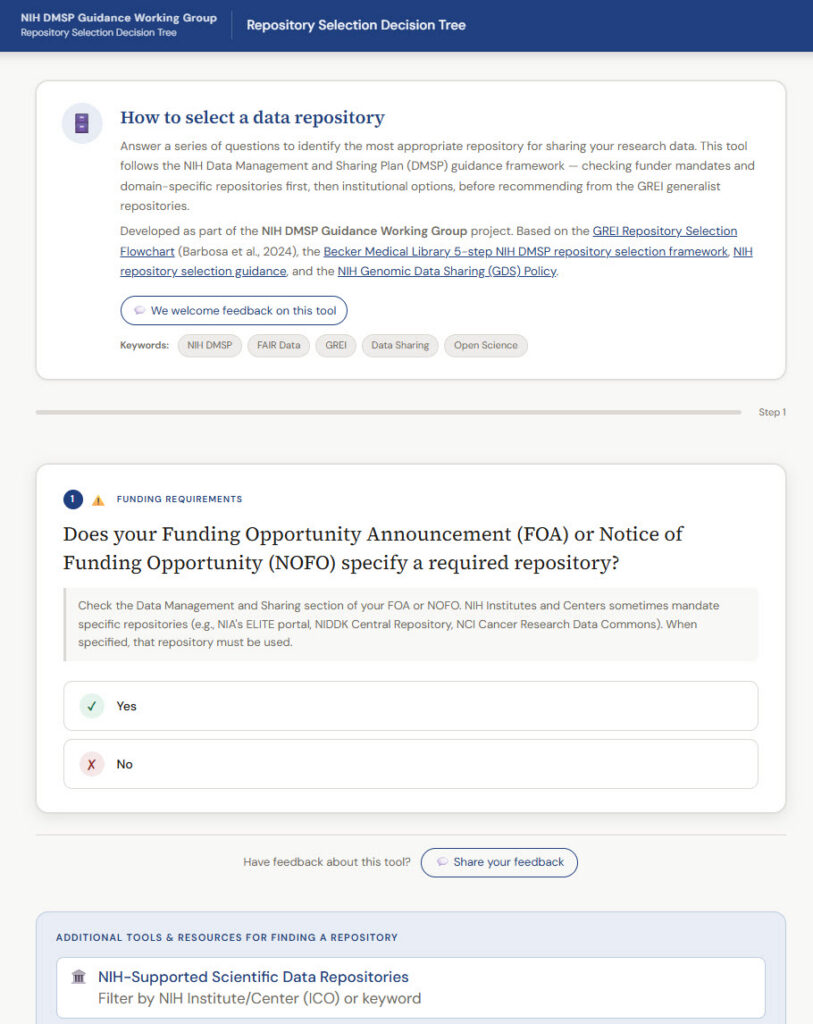
- Repository Selection to fill out Element 6: Use the Interactive Repository Selection Decision Tree tool (Figure 2) to identify appropriate repositories for each anticipated data type by answering a series of decision questions. We do have an institutional data repository, Digital Commons Data@Becker, for WashU Medicine offering a free curation service and no deposit fees.
- Justifiable factors for limiting scientific data sharing to help fill out Element 4:
I hope these additional clarifications and new resources are useful to you.
We are happy to assist with every stage of the data sharing process, from developing a compliant DMS Plan and selecting appropriate repositories to preparing datasets for sharing and publishing curated datasets in Digital Commons Data@Becker. If you are preparing an NIH application, don’t hesitate to request a consultation!