Announcements, Science and Informatics

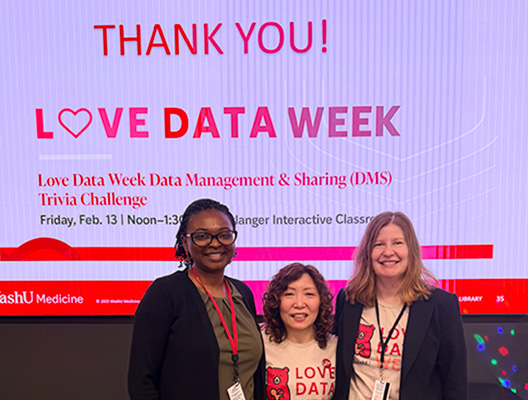
Love Data Week 2026: DMS Trivia Challenge Brings Energy, Competition, and Community

What happens when you mix analysts, clinical research staff, directors, PhD students, marketing leaders, agile operations managers, and add walk-up songs and a Party Rocker? You get the first-ever DMS Trivia Challenge at Love Data Week 2026. Hosted by the Becker Data Management and Sharing (DMS) Team, the event brought together 11 teams representing roles  [Read more]
Mastering Information, Science and Informatics

NIH DMS Plan Format Updates, 2026 Edition: What to Know

The National Institutes of Health (NIH) will implement an updated format for Data Management and Sharing Plans (DMSPs) effective May 25, 2026 (NOT-OD-26-046). While the underlying 2023 NIH Data Management and Sharing Policy remains unchanged, this new format reflects NIH’s broader effort to reduce administrative burden and improve consistency in how plans are written, reviewed,  [Read more]

Science and Informatics

Tips for Submitting RNA-seq Data to GEO 

We have received several inquiries about depositing RNA-seq data generated by WashU’s Genome Technology Access Center (GTAC) into the Gene Expression Omnibus (GEO) repository managed by the National Center for Biotechnology Information (NCBI). As a result, it is a good time to write a blog article providing guidance on this issue for researchers on campus.  [Read more]

Science and Informatics

Best Practices for Reproducible AI Research in Life Sciences – Introducing DOME

In recent years, there has been exponential growth in the use of machine learning (ML) in the life sciences, fueled by increased access to powerful hardware (e.g., GPUs) and high-quality FAIR biodata enabled by the open science movement. One standout example is AlphaFold, which uses ML to predict protein structure from genetic sequences, a breakthrough  [Read more]

Science and Informatics

A Becker Guide for Proteomics Data Repositories Part 3

In the first two parts of this blog series, I introduced the main player in the proteomics data repository ecosystem, the ProteomeXchange (PX) Consortium. Outside of the PX Consortium, there are an additional handful of repositories holding proteomics data. These additional repositories serve special cases or certain scientific communities, but it may be useful for  [Read more]

Science and Informatics

A Becker Guide for Proteomics Data Repositories Part 2

In the first part of this blog series, I provided an overview of the ProteomeXChange (PX) Consortium and introduced its most important member – the PRIDE Database. I also introduced ProteomeCentral, the common portal providing the ability to browse and search all of the public datasets within the PX Consortium member repositories. Here in the  [Read more]

Science and Informatics

A Becker Guide for Proteomics Data Repositories Part 1

Introduction Proteomics, the large-scale study of proteomes, is a highly valuable tool in biomedical research, but because most proteomics approaches are based on mass spectrometry (MS), the analytical chemistry nature can be a barrier to some biologists and physician-scientists. In this series of three blog articles, I would like to introduce MS-based proteomics data by  [Read more]

Mastering Information, Science and Informatics

Tips for Writing NIH Data Management and Sharing Plans

The National Institutes of Health (NIH) requires a Data Management and Sharing Plan (DMSP) in all competing applications that generate scientific data. A DMSP should cover six key elements as outlined in NOT-OD-21-014.  While not required, using a DMSP template helps researchers address all six elements and sub-elements required by the NIH DMS policy. The  [Read more]

Science and Informatics

Check out Dataset Catalog beta from the National Library of Medicine

Earlier this year, the National Library of Medicine (NLM) announced the launch of the beta version of a new online tool called the Dataset Catalog. This tool is intended to be the “PubMed of datasets” to help users search, find and retrieve datasets in multiple repositories through a single, user-friendly interface. Dataset Catalog beta currently  [Read more]

Mastering Information, Science and Informatics

How to Make Your Protocols Complete, Interactive, and Citable

Are you frustrated by incomplete methods in publications that lack critical details? Are you seeking a simple solution to document comprehensive step-by-step protocols, complete with information on reagents and equipment, and a dedicated space to note any protocol deviations? In research settings, reproducible experimental methods are of utmost importance. Fortunately, protocols.io offers a solution where  [Read more]

1 2 3